Ghosts
The SympathizerGhosts recur as more than figures of supernatural fear: they make the unnamed narrator’s unresolved guilt feel present, watching, and difficult to escape. The crapulent major’s ghost, in particular, turns a killing into an ongoing relationship, appearing beside the narrator and intruding on his thoughts. Yet the narrative leaves open whether these encounters are supernatural visitations or the forms taken by memory and remorse. That uncertainty lets haunting operate at once as a belief about the afterlife and as a consequence of what the living have done.
Belief, Fear, and Uncertainty
The narrator sets ghosts against religious belief. He does not believe in God, but he says he believes in ghosts, explaining that he fears them whereas he does not fear God. This contrast makes the ghostly presence more than an abstract question about what survives death: it has a power over him that divine judgment does not. His confidence in ghosts is personal and experiential, grounded in the appearance of the crapulent major’s ghost, while the narrator’s own unease keeps the cause of that appearance unsettled.
The account does not supply an independent confirmation that ghosts exist. At moments, the major seems to appear bodily; at others, his presence is an inward voice interrupting the narrator’s thoughts. The narrator also recognizes the difficulty of distinguishing himself from his own mind: self-conversation can be compelling, but the major keeps intruding into it. Rather than resolve the uncertainty, the narrative makes it part of the haunting. The major may be a dead man who can still watch, or the narrator’s guilt giving a voice and shape to what he cannot put aside.
The Crapulent Major as Haunting Witness
The major’s ghost is attached to the narrator’s responsibility for his death. At the apartment of the major’s widow, the narrator remembers the major’s body lying on its back, with the third eye in his forehead and his other eyes open and blank. The image follows him into the visit: he fears that the hand on the doorknob might be the dead man’s. Instead, the widow opens the door. His fear is already affecting a meeting intended as an act of restitution, before any apparition is visible there.
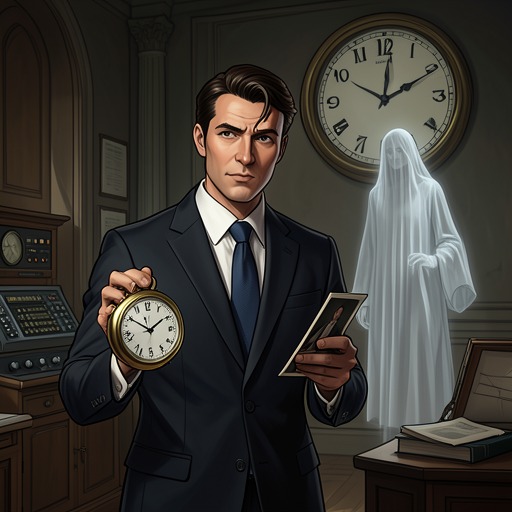
The widow’s grief makes the dead man present in another way. When she urges the narrator to have another ladyfinger, his reply recalls the exact words her husband used, and she begins to cry. The narrator then sees the major’s photograph on a side altar and imagines his gaze fixed on him as he comforts the widow. The scene joins ordinary mourning to the narrator’s particular dread: the photograph is a memorial for the family, but for him it also becomes a place from which the dead man seems to watch.
After offering the widow money and promising to help her and her children, the narrator leaves a different kind of offering for the major. A Playboy opened to Miss June remains in the car, intended for the ghost. The gesture combines dark humor with an effort to address the dead as someone whose wishes might still matter. The narrator imagines the major receiving it in an afterlife where offerings are unequal: some dead are honored with abundant food and drink, while the major has only a moldy orange, a can of Spam, and Lifesavers before his photograph, lit by blinking Christmas lights. This inventory makes the afterlife continuous with earthly social distinctions, while the narrator’s promise of an offering acknowledges that his guilt has not ended with the major’s death.
Voices, Surveillance, and Guilt
The haunting returns during a drive with the General. As rumors about the General’s political movement spread through the exiled community, the narrator senses the crapulent major in the seat beside him, his body spilling over the bucket seat. The major is not just a frightening remnant of the past: he is a spectator following the narrator into the present. The narrator recalls that he did not personally make the hole that gave the major his third eye, but he devised the plot that led to the major’s fate. That distinction does not release him from responsibility. In the narrator’s imagination, the third eye lets the dead man continue watching the person whose scheme helped bring about his death.
The major’s voice also turns haunting into an accusation about agency. He reminds the narrator that the plot has taken on a life of its own and that its originator may be the only person able to stop it. The narrator cannot answer aloud while driving the General, and the effort to hold his tongue makes the imagined exchange feel like a pressure he must contain. The ghost thus connects an earlier killing to continuing political consequences: what the narrator helped set in motion has not stayed safely in the past.
The narrator’s guilt does not belong to the major alone. After Sonny is killed, the narrator hears his mother’s voice asking whether he will be better than the others. The voice is presented as something heard within the scene, not as a clearly established apparition. Its effect nevertheless resembles the major’s haunting: a dead or absent person enters the narrator’s awareness at a moment when he must confront what he has done. As he departs America with Bon, he imagines both the crapulent major and Sonny beside him on the plane. The dead travel with the living, occupying the narrator’s thoughts as he leaves the place where the killing occurred.
Narrative Role and Significance
These returns give ghosts a narrative function as witnesses who cannot be dismissed by a change of setting or by the narrator’s attempts to resume ordinary life. The major appears in the narrator’s fear at the widow’s door, in the family’s memorial space, in the car with the General, and in the narrator’s later imagined company. Each return changes the emphasis: fear becomes remorse, remembrance becomes surveillance, and guilt becomes a question about what follows from an act already committed.
The account also resists treating belief in ghosts as a simple escape from responsibility. The narrator’s rituals and offerings may be attempts to appease the dead, but they cannot undo the major’s death. His visit to the widow and his concern for her children offer material help; his imagined gift to the major addresses the afterlife he fears. Neither act removes the haunting. Ghosts therefore hold together two possibilities without settling them: that the dead persist beyond death, and that the living carry their actions forward in memory, fear, and the voices they cannot silence.